AC vs DC EV Chargers: What Is the Difference and Which One Do You Need?
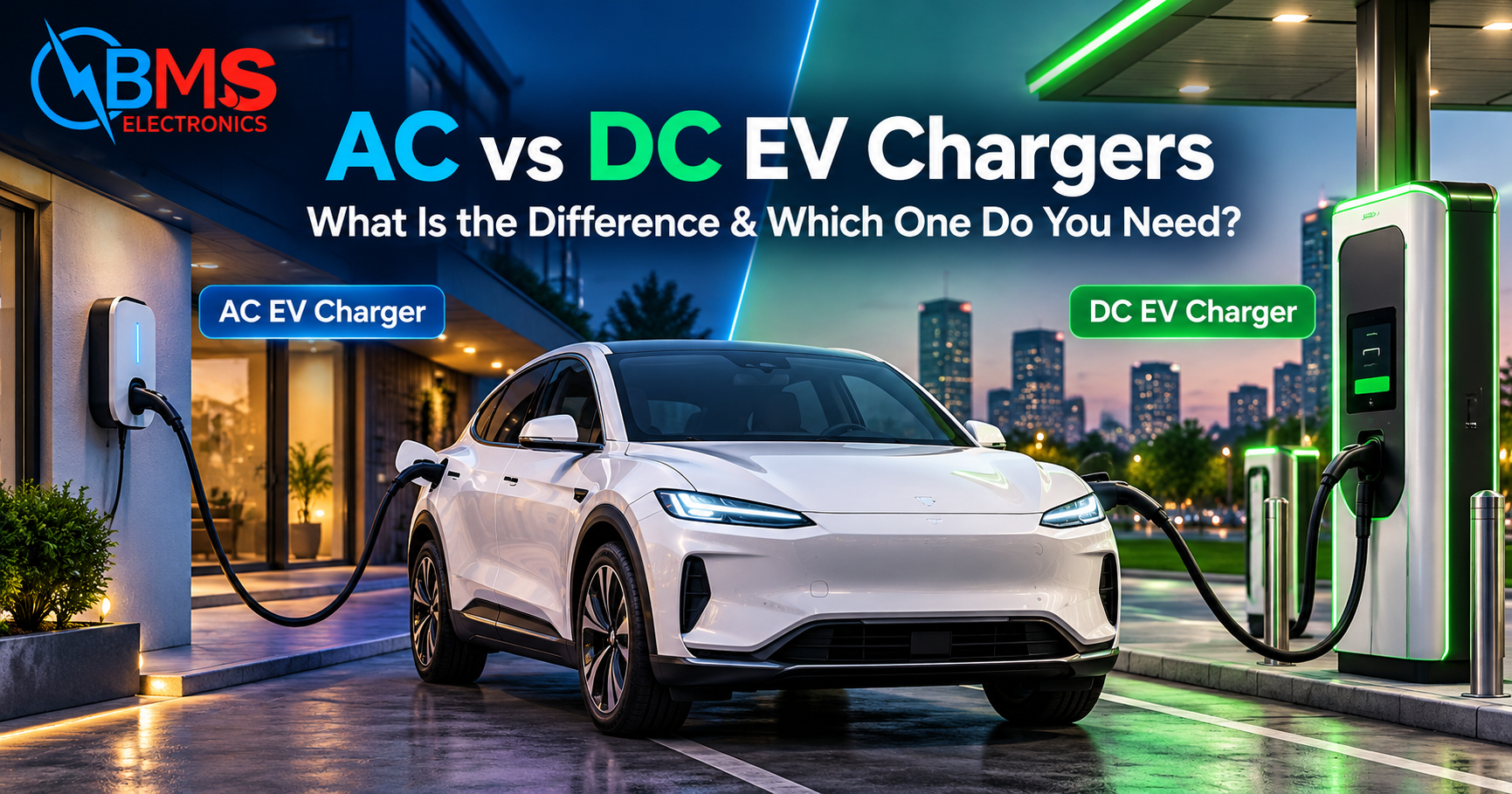
Electric vehicles (EVs) are becoming increasingly common, and choosing the right charging solution is an important part of EV ownership and infrastructure planning. Two of the most common types of EV chargers are AC EV chargers and DC EV chargers.
Although both are designed to charge electric vehicles, they work differently, offer different charging speeds, and are suited to different applications.
So, what is the difference between AC and DC EV chargers? And which one should you choose for your home, workplace, commercial property, or EV charging station?
This guide explains the difference between AC vs DC EV chargers, how they work, their charging speeds, costs, applications, and the key factors to consider before choosing an EV charging solution.
AC vs DC EV Chargers: Quick Overview
The main difference between AC and DC EV charging is where the electricity is converted from alternating current (AC) to direct current (DC).
With AC charging, the AC electricity supplied by the electrical grid is converted into DC power by the vehicle's onboard charger before it reaches the battery.
With DC charging, the conversion happens inside the charging equipment. The charger supplies DC power directly to the vehicle's battery, which allows for much faster charging.
|
Feature |
AC EV Charger |
DC EV Charger |
|
Power supplied |
AC |
DC |
|
Power conversion |
Inside the vehicle |
Inside the charger |
|
Charging speed |
Generally slower |
Generally faster |
|
Typical application |
Homes, offices, workplaces |
Public and commercial charging |
|
Installation |
Usually simpler |
More complex |
|
Infrastructure requirement |
Lower |
Higher |
|
Best suited for |
Long-duration parking |
Fast charging and quick turnaround |
|
Cost |
Generally lower |
Generally higher |
The right choice depends on how, where, and how frequently the EV will be charged.
What Is an AC EV Charger?
An AC EV charger supplies alternating current to an electric vehicle.
Electricity from the grid is normally supplied as AC. However, an EV battery stores electricity as DC. Therefore, when an EV is connected to an AC charger, the vehicle's onboard charger converts the incoming AC electricity into DC before sending it to the battery.
This makes AC charging particularly suitable when a vehicle will remain parked for several hours.
How Does AC EV Charging Work?
The basic process is:
Electrical Grid → AC EV Charger → Vehicle Onboard Charger → EV Battery
The AC charger controls and manages the charging connection, while the vehicle's onboard charger performs the AC-to-DC conversion.
The maximum charging speed depends on several factors, including:
-
Vehicle onboard charger capacity
-
Charger power rating
-
Available electrical supply
-
Charging connector
-
Battery capacity
-
Battery state of charge
Where Are AC EV Chargers Commonly Used?
AC chargers are commonly suitable for locations where vehicles remain parked for longer periods, such as:
-
Residential properties
-
Apartment buildings
-
Offices
-
Workplaces
-
Hotels
-
Shopping areas
-
Parking facilities
-
Fleet parking locations
For many EV owners, AC charging is convenient because the vehicle can charge while it is parked overnight or during working hours.
What Is a DC EV Charger?
A DC EV charger, often called a DC fast charger, converts AC electricity into DC electricity within the charging equipment itself.
The charger then supplies DC power directly to the vehicle's battery.
The basic process is:
Electrical Grid → DC EV Charger → EV Battery
Because the conversion does not rely on the vehicle's onboard AC charger, DC charging can deliver substantially higher charging power where the vehicle and charging infrastructure support it.
How Does DC Fast Charging Work?
When an EV is connected to a DC charger, the charging station communicates with the vehicle to determine the appropriate charging parameters.
The charger converts electrical power and delivers DC power directly to the battery.
Charging performance depends on factors such as:
-
Charger power rating
-
Vehicle maximum DC charging capability
-
Battery temperature
-
Battery state of charge
-
Charging curve
-
Electrical infrastructure
-
Connector and charging standard
This is why installing a higher-power DC charger does not necessarily mean every EV will charge at that maximum power.
AC vs DC EV Chargers: What Is the Difference?
The biggest difference between AC and DC EV chargers is how the power reaches the vehicle battery.
1. Power Conversion
In AC charging, the vehicle's onboard charger converts AC electricity into DC.
In DC charging, the charging station performs the conversion before supplying DC power to the vehicle.
2. Charging Speed
AC charging is generally slower than DC fast charging.
AC charging is often ideal when an EV can remain connected for several hours.
DC charging is designed for situations where drivers need to recharge in a shorter period.
However, actual charging speed varies from one EV and charger to another.
3. Installation Requirements
AC chargers generally require less demanding electrical infrastructure than high-power DC charging systems.
High-power DC chargers may require:
-
Higher electrical capacity
-
More substantial cabling
-
Appropriate protection equipment
-
Suitable switchgear
-
Proper site planning
-
Adequate cooling and equipment space
Therefore, installation requirements should be evaluated before selecting a DC charging system.
4. Cost
AC chargers are generally less expensive to purchase and install than high-power DC charging systems.
DC charging equipment can involve higher equipment, installation, electrical infrastructure, and maintenance costs.
The total project cost depends on factors such as:
-
Charger power
-
Number of charging points
-
Electrical connection
-
Site conditions
-
Civil work
-
Cable requirements
-
Protection systems
-
Installation complexity
5. Typical Use Case
AC chargers are generally better suited to locations where vehicles remain parked for longer periods.
DC chargers are more suitable where rapid charging and high vehicle turnover are important.
AC vs DC EV Charging Speed
Charging speed is one of the biggest reasons people compare AC and DC chargers.
However, charging speed should not be judged only by the charger's maximum power rating.
For example, if a vehicle supports a lower charging power than the charger can provide, the vehicle will generally limit the charging rate.
Similarly, charging speed can change as the battery approaches a high state of charge.
What Determines EV Charging Speed?
Several factors affect charging speed:
1. Charger power
Higher-power charging equipment can potentially deliver more energy in a given period.
2. Vehicle charging capability
The EV determines how much power it can accept.
3. Battery capacity
A larger battery generally requires more energy to reach a similar state of charge.
4. Battery temperature
Battery temperature can influence charging performance.
5. State of charge
Charging power may reduce as the battery approaches a high state of charge.
Therefore, the advertised charger power should not be treated as a guaranteed charging speed for every EV.
AC vs DC EV Chargers: Which Is Better for Home Charging?
For many home users, an AC EV charger is a practical choice.
If the vehicle is parked at home overnight, there may be enough time to recharge without requiring high-power DC charging.
AC charging can be particularly useful for:
-
Daily commuting
-
Overnight charging
-
Private parking
-
Residential buildings
-
Long parking periods
A home charging solution should be selected according to the vehicle's charging capability, available electrical capacity, parking arrangement, and expected daily driving distance.
When Might DC Charging Be Useful at Home?
DC charging can be considered in situations where very fast charging is a priority and the property has suitable electrical infrastructure.
However, higher-power DC systems can require significantly more infrastructure and investment than typical residential AC charging.
For this reason, the application should be evaluated before choosing a DC system for a residential location.
Which Is Better for Commercial EV Charging?
For commercial applications, the choice between AC and DC depends heavily on how vehicles use the site.
AC Charging for Commercial Locations
AC chargers can be suitable for:
-
Office parking
-
Hotels
-
Apartment complexes
-
Employee parking
-
Long-stay commercial properties
-
Fleet parking
They are particularly useful when vehicles remain parked for several hours.
DC Charging for Commercial Locations
DC chargers can be more appropriate for:
-
Public charging stations
-
Highway charging locations
-
Fleet operations with short turnaround times
-
Taxi and ride-hailing fleets
-
Logistics operations
-
High-traffic commercial locations
If vehicles need to return to operation quickly, DC fast charging can offer an important operational advantage.
AC vs DC Charger: Which One Do You Need?
There is no single charger that is best for every EV application.
Use an AC EV charger when:
-
The vehicle can remain parked for several hours.
-
Overnight charging is convenient.
-
Charging speed does not need to be extremely high.
-
You are installing charging at a home or workplace.
-
You want a comparatively simpler charging setup.
Consider a DC EV charger when:
-
Fast charging is a major requirement.
-
Vehicles have short parking or turnaround times.
-
The site serves many EV drivers.
-
You are developing a public charging station.
-
Fleet vehicles need to return to operation quickly.
Factors to Consider Before Choosing an EV Charger
Before purchasing an AC or DC EV charger, consider more than just charging power.
1. Vehicle Compatibility
Check the EV's supported charging standards, connectors, and maximum AC/DC charging capabilities.
2. Required Charging Time
Consider how long vehicles normally remain parked.
A vehicle parked overnight may not need the same charging solution as a vehicle that needs to return to the road within a short period.
3. Electrical Infrastructure
Evaluate the available electrical supply and whether additional electrical infrastructure is required.
4. Number of Vehicles
A residential charger for one EV has very different requirements from a commercial site serving multiple vehicles.
5. Installation Cost
Consider the complete project cost rather than only the charger price.
This may include:
-
Electrical work
-
Cabling
-
Protection equipment
-
Civil work
-
Installation
-
Commissioning
-
Networking or software requirements
6. Future Requirements
If EV adoption at your location is expected to increase, consider whether the charging infrastructure can be expanded later.
Planning for future charging demand can help avoid unnecessary redesign or replacement.
AC vs DC EV Chargers: Pros and Cons
AC EV Charger Advantages
-
Suitable for overnight and long-duration charging
-
Generally simpler infrastructure
-
Usually lower equipment cost
-
Suitable for residential and workplace charging
-
Convenient for regular daily charging
AC EV Charger Limitations
-
Generally slower than DC fast charging
-
Charging speed can be limited by the vehicle's onboard charger
-
May not be suitable when vehicles require rapid turnaround
DC EV Charger Advantages
-
Much faster charging potential
-
Suitable for public charging
-
Useful for high-utilization fleets
-
Reduces charging downtime
-
Suitable for locations where fast turnaround is important
DC EV Charger Limitations
-
Higher equipment cost
-
More demanding electrical infrastructure
-
More complex installation
-
Higher project requirements for high-power applications
Can an EV Use Both AC and DC Charging?
Yes. Most modern electric vehicles are designed to support both AC and DC charging, although the supported charging standards and maximum charging power depend on the specific vehicle.
AC charging is often used for regular or overnight charging, while DC fast charging can be used when faster charging is required.
The exact charging capability should always be checked against the vehicle manufacturer's specifications.
Does DC Charging Damage an EV Battery?
Using DC fast charging does not automatically mean that an EV battery will be damaged.
Modern electric vehicles use battery management systems to control charging conditions.
However, charging performance and battery characteristics can vary depending on the vehicle, battery technology, temperature, charging conditions, and usage pattern.
Following the vehicle manufacturer's charging recommendations is the best approach.
How to Choose the Right EV Charger
Choosing the right EV charger starts with understanding the actual charging requirement.
Ask these questions:
-
How many EVs need to be charged?
-
How long will each vehicle remain parked?
-
How quickly must the vehicle be ready?
-
Does the vehicle support AC charging, DC charging, or both?
-
What electrical capacity is available at the site?
-
What charging power is actually required?
-
What is the available installation budget?
-
Will charging demand increase in the future?
Once these factors are understood, it becomes much easier to decide between AC and DC charging.
Before selecting a charger, compare the available EV chargers and charging solutions based on your vehicle, charging requirements and installation conditions
AC vs DC EV Chargers: Final Verdict
The choice between AC vs DC EV chargers depends on the application rather than simply choosing the charger with the highest power.
AC EV chargers are generally well suited to homes, offices, hotels, apartments, and other locations where vehicles can remain parked for longer periods.
DC EV chargers are better suited to applications where faster charging and shorter vehicle turnaround times are important, such as public charging stations and high-utilization commercial fleets.
For the right charging solution, consider your vehicle's charging capability, required charging time, electrical infrastructure, budget, site conditions, and future charging demand.
If you are evaluating EV charging solutions for a residential, commercial, or fleet application, choosing the right charger specification is an important first step toward building an efficient and practical charging setup.
Frequently Asked Questions
1. What is the main difference between AC and DC EV chargers?
The main difference is where AC electricity is converted into DC power. With AC charging, conversion happens inside the EV's onboard charger. With DC charging, conversion happens inside the charging station and DC power is supplied directly to the battery.
2. Is AC or DC charging faster?
DC charging is generally faster because DC chargers can supply higher charging power directly to the vehicle battery. Actual charging speed depends on the charger and the EV's charging capability.
3. Is an AC EV charger good for home use?
Yes. AC chargers are commonly suitable for home charging, particularly when an EV can remain parked overnight or for several hours.
4. When should I choose a DC EV charger?
A DC EV charger can be appropriate when fast charging and short vehicle turnaround times are important, such as at public charging stations and high-utilization commercial or fleet locations.
5. Are DC EV chargers more expensive than AC chargers?
Generally, DC charging systems have higher equipment and installation costs because they can require higher electrical capacity and more complex infrastructure.
6. Can the same EV use both AC and DC chargers?
Many modern EVs support both AC and DC charging, but the supported charging standards and maximum charging power vary by vehicle.
7. Does a higher-power EV charger always charge an EV faster?
No. The vehicle's maximum charging capability, battery condition, temperature, state of charge, and other factors can limit the actual charging power.
8. Which EV charger should I choose?
Choose based on your charging time requirements, vehicle compatibility, site electrical capacity, budget, number of vehicles, and intended application. AC is generally suitable for longer parking periods, while DC is more appropriate when faster charging is required.
Conclusion
Understanding the difference between AC and DC EV chargers makes it easier to choose the right charging solution for a particular application.
AC charging is a practical option for long-duration charging, while DC charging provides faster charging for situations where reducing charging downtime is important.
Before selecting an EV charger, always evaluate the EV's charging capability, site infrastructure, charging demand, installation requirements, and future needs. The right solution is the one that matches the way your vehicles are actually used.
For professional guidance on EV charging solutions, explore the relevant products and charging solutions available from BMS Electronic.